
Local council elections are nearly here, and we’re being subjected to the same boring marketing tactics from candidates desperate for our votes.
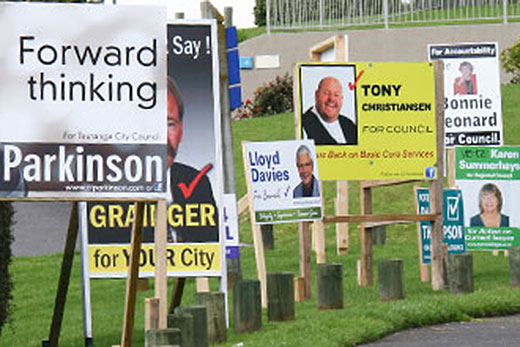
Roadside signs cluttering our suburbs, low turnout town-hall meetings, and my guess is that we’re going to get the awkward horn-tooting pleas on election day.
It’s all so predictable and, quite honestly, ineffective.
When marketing is about cutting through the noise and bringing awareness to your brand/message, why are our political hopefuls stuck in such a rut?
In the context of local body elections (or any election for that matter) marketing is about getting as many of your target market (residents of voting age) as possible to:
Know who you are (brand awareness)
- Know what you stand for (messaging)
- Know how you can help them (brand education)
- Know how to vote for you (close the sale)
I’m 40 years old, and for as long as I can remember, campaigning is always done the exact same way.
- Put out signs on the side of the road with your face and name on it
- Maybe hold some local “town-hall” style meetings where you can share your views
- MAYBE stand on the side of the road, with your closest family and friends, on election day, asking drivers to toot their horns in support.
- Hope like hell that people are going to vote for you on election day
There’s very little thought put into it.
Very little creativity.
When marketing is all about standing out from the noise, should it even be considered “marketing”?
I was recently in a conversation with a friend about the signs on the side of the road.
He was letting me know that he saw a sign from a candidate that got his attention, in the fact that while he was zooming past all of the signs, there was one that stood out slightly from the others.
Interestingly enough, although this conversation was less than 2 weeks ago, and I’m in the business of marketing and getting clients to stand out, I can’t remember the candidate’s name, or the reason why he stood out.
My friend commented, “What’s the point of all of those signs? What are they (the candidates) trying to achieve from putting them out there when it’s not possible to understand what the candidates stand for?”
The obvious and clear answer is simple brand awareness.
Brand awareness can be the only outcome with this kind of marketing.
Drivers aren’t going to stop and look at each sign to see the finer details, so this strategy is all about being seen – nothing else.
Every candidate has a roadside sign.
So, with that in mind, what are candidates doing to build on this “awareness”?
Not much…
In my area, I am aware of maybe a handful of “town-hall” style meetings where local candidates can share their vision for the city.
As a resident in a smaller city, I have only been made aware of a few of these as a result of seeing some controversies after the fact and only because I happen to be a member of a few local Facebook groups.
If it wasn’t for these Facebook groups, I wouldn’t have seen the controversies, and if it wasn’t for the controversies, nothing would have been posted to the Facebook groups.
Basically, unless you’re extremely plugged in and deliberately hunting for information, you’re not going to know about any of these events.
Here’s the thing: when you think about marketing, the absolute first thing you need to do is to understand your target market.
This informs absolutely everything you do in your marketing strategy to bring awareness and your message to the people you need to get in front of.
For local body candidates, they seem to be utilising a strategy of “let’s do what’s always been done and it should work out alright”.
Voting rates at local body elections are notoriously low.
I’m just speculating here, but could it be that people don’t get out and vote, not because they’re apathetic to what’s going on in their city, but because they have no idea who the candidates are or what they stand for?
Could it be that candidates do such a poor job at marketing that candidates abstain from voting because they don’t have enough information?
Could it be that those with some kind of name recognition before getting into local government are more likely to win, simply because those who know who they are vote, and everyone else stays at home on election day, wishing they knew more about the other candidates?
Based on the last local body elections in 2022, the region with the highest voter turnout was Invercargill, with just 53.2%.
53.2%.
That means that almost half of your eligible voters didn’t vote.
What about some of the other cities around the country?
Wellington – 45%
Christchurch – 43.31%
Auckland – 35.4%
In Porirua, where I currently live, the voter turnout in 2022 was just 37.3%.
Almost 63% of eligible voters in Porirua didn’t vote…
And even though we are constantly reminded about how low voter turnout is, and how disengaged people seem to be in local body elections in New Zealand, the marketing tactics of the candidates haven’t changed at all from the last cycle.
Imagine you’re a candidate who decides to target the disengaged voters.
Imagine you research this group of people before the campaigning starts so you can understand why they’re not voting (market research).
Imagine taking this information and using it to inform your marketing strategy and messaging.
What a crazy idea that would be!
Imagine getting the vote of that audience.
In Porirua, you would have a 62% majority.
In Wellington, you would have 55%.
In Auckland, 64%.
But that’s too much work, so we follow the same gameplay as everyone else and stay in our boring little lane.
The crazy thing is that these candidates will all claim that they want to run your city on “behalf of the people”, yet the majority of residents don’t currently vote.
This means by taking the time to research and deliver what the disengaged voters actually want, you will be delivering exactly what the majority of the residents are crying out for – now there’s a radical thought, actually listening to the majority…
OK, it’s easy to sit here in my high tower and cast judgment on those who are at least willing to step out and make their city a better place to live, but I genuinely want to provide some solutions to the problem.
So, how could local body candidates improve their marketing and generate a higher overall voter turnout?
I would suggest the exact same 3-step, common sense, approach that we take with any business we work with:
- Inward Audit and research
- Target market research
- Develop a plan based on your research
Inward Audit and Research:
Take the time to write out and be very clear on what it is you stand for as a candidate.
What is your vision for the city?
What motivates you?
What sets you apart from other candidates?
Next, research voting trends, other candidates, and the political environment.
Why do all of this?
You can not expect anyone to vote for you if you’re not clear on what it is you want to achieve.
If there’s nothing that makes you stand out from other candidates, this will help you recognise this so you can work on being “different” – and I’m going to say it, your race shouldn’t be the thing you rely on to make you stand out.
Once you are clear on your internal situation, you can use this to drive your next steps.
For example, if you stand out because you’re young – 18 – 25 – you can use this to speak to those in your age group, but you can also look into what the older voters wouldn’t like about this, so you can overcome their objections before they have them.
If you think the thing that makes you different is that you’ve lived in your city for your entire life (let’s say 60 years), you can use this to show your love and dedication to the city. But you can also think about overcoming objections from those who think 60 years old is too old to be running a city.
Target Market Research:
I touched on this earlier, about how you can easily research the non-voters and use this information to attract them to vote for you.
Ultimately, you want to identify a primary audience who you want to target in your marketing/election campaign.
The lazy way of doing this is by thinking that your message will just attract like-minded people to vote for you.
While this is correct, it also means your entire marketing campaign is going to be based on hoping people hear your message.
By identifying specific groups of people, you can modify your delivery and context of your messaging to speak directly to these groups and have greater success in convincing them to vote for you.
You also want to identify a target audience that is going to be large enough to get you victory.
In Wellington in the 2022 election, there would have been no point in targeting just those aged between 18 – 25 because they made up just 10% of the votes – you would have lost.
Once you have identified your target audience, you can then research what motivates them, what concerns them about the city, and what would cause them to vote for someone.
But most importantly, you can identify exactly how your target audience wants to be marketed to – aka where they hang out, how they consume information, and what motivates them to make decisions.
Developing a Plan Based on Your Research:
This is where you take all of the information, your vision, the competitor research, the knowledge of the political climate, and your target market research, and you use it to develop a strategy on how to market yourself and your candidacy.
If you have done your target market research well, by this stage, you should know exactly how to get in front of your target audience and exactly what messaging to use to get your message across.
Your plan will have a clear, step-by-step action plan.
What marketing outlets to use, how long to use them for, why they’re being used, and what kind of estimated budget should be spent on each area.
I can almost guarantee you that there are ZERO target audiences out there who really want candidates to put signs up along the side of the road, which means I can also be confident in making claims that close to 100% of candidates do absolutely no target market research.
Now, without knowing anything about the target markets of any specific local body candidates, here are some easy marketing suggestions, based on what I have/haven’t seen this (or any) election cycle.
Please note that I am not aware of any marketing restrictions that may be on candidates.
Brand Awareness
Oddly enough, I would recommend keeping the roadside signs, but only because you could alter them slightly to stand out from the crowd.
Every sign looks identical, so here are some options:
1. Make the sign just your face and name, cut it out so the sign is no longer square, but is literally JUST your face and name. All attention will be driven to your sign because it looks different.
2. We all know these signs get vandalised and drawn on. Create a sign that is pre-vandalised, where your face already looks like it’s been given a moustache and glasses etc. – especially if you’re female. Then turn up in other marketing material and events with the same “moustache and glasses”. People will see your sign with identical “vandalism” around the city, and it will generate a conversation. You will be remembered much more easily.
Obviously, this is a very comical idea, but sometimes it’s the comical ideas which get you places because no one is expecting them.
Remember, with the signs, it’s purely brand awareness. Put yourself out there and make yourself memorable.
Next on the awareness front, run some flippin Meta ads!
Honestly, why aren’t candidates doing this??
You can just run blanket ads to people who are in certain areas. Choose the city you’re running in and click “publish”. Everyone in that city will see your ads when they’re on Facebook and/or Instagram.
The ads don’t have to be anything special.
Think of them as an extension of the roadside signs.
Purely awareness.
In fact, run the same image that is on your roadside sign.
If you’ve taken the “pre-vandalised” approach to the sign, put up the same image on these ads with the message “you might have seen my signs” and then 2 sentences about who you are and why you’re running for council.
Messaging Awareness
Keep on the Meta ads bandwagon here because you can target your target audience so well.
Record a bunch of videos (20 – 40 seconds) and push them out to social media.
Run the most popular videos as ads to your target audience.
Here’s a wild idea – go out to the public, walk the streets with a camera and ask random people if they’re going to vote, who they’re thinking of voting for and why. Ask them what concerns them the most about the city. Ask them what they would do if they were Mayor.
Put these videos on your social accounts.
For the videos where people have voiced concerns about specific areas of council (eg council spending etc.) post the video of their concern along with a video of your reply (which can be recorded separately and turned into a single video)
Again, if any videos where you are interacting with the public and you share your messaging that do particularly well organically, push them out to the wider community was ads.
Building Authority and Trust:
Show up to as many events as you possibly can.
Publish that you will be at these events.
Stick around and answer questions.
Don’t just post to Facebook that you’re be at certain events, get on the phone and call people to let them know. Do letterbox drops.
Show people you care.
If you put the effort in, people will see this and respect you for it.
People want hard workers to represent them in council.
Here’s the thing – every event you do, every action you take, get it on camera and turn it into content you can get to your audience!
These are just a few ideas based on the fact that I have never seen any local body candidate do any of this.
It’s not rocket science.
It’s just hard work.
If you’re not willing to work hard for their vote, why would they expect you to work hard once elected?
It’s just common sense.